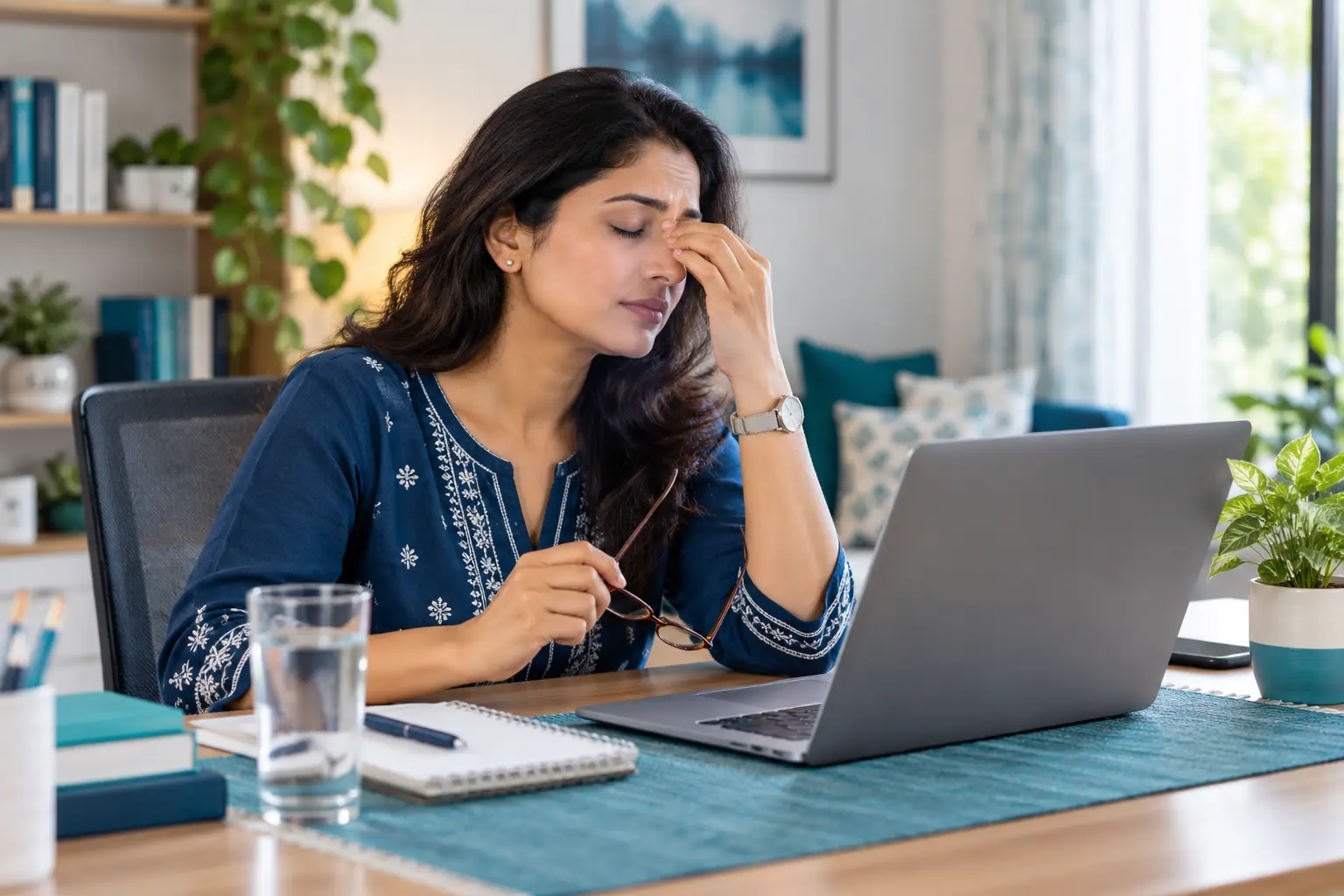
Do you keep moving your phone away to read a message? Perhaps newspaper print looks blurred, or threading a needle takes more effort than before.
If these changes develop gradually after 40, one possible explanation is presbyopia: the normal, age-related reduction in the eye’s ability to focus on nearby objects. It does not mean that you have suddenly damaged your eyes.[1]
However, age alone cannot explain every change in eyesight. A comprehensive eye examination can confirm the cause and help identify suitable correction.
What Happens Inside the Eye?
The natural lens inside your eye helps focus light onto the retina, the light-sensitive layer at the back of the eye. When you are younger, the lens changes shape readily to focus at different distances.
With age, the lens becomes less flexible. Focusing on small print nearby becomes harder, so moving a phone or book farther away may make it clearer.[1]
Presbyopia is not exactly the same as hyperopia, commonly called long-sightedness. Hyperopia involves the eye’s focusing characteristics, while presbyopia reflects the gradual loss of flexible near focusing with age. A person can have both.
Common Signs You May Notice
The change is usually gradual. You may notice:
- Small print becoming blurred at your usual reading distance
- Holding a phone, book or menu farther away
- Difficulty with sewing or other detailed close work
- Tired eyes or headaches after prolonged reading
- A growing preference for larger text or brighter reading light
These symptoms can interrupt work, household tasks and leisure activities. They are a reason to arrange an examination, not proof of a diagnosis. Mention whether one eye seems different from the other and whether distance vision has changed too.[2]
Who Develops Presbyopia?
Age is the main factor. Many people start noticing difficulty in their forties, although the timing varies. Presbyopia can occur even if you have never needed spectacles. People who already wear distance glasses can develop it too.[1]
If reading difficulty begins unusually early, tell the ophthalmologist about your medical history and medicines. Some health conditions and medicines can affect near focusing. Do not stop a prescribed medicine yourself. An assessment is particularly important when symptoms do not follow the usual gradual pattern.[2]
Simple Changes That May Make Reading Easier
While arranging an examination, you can:
- Increase text size. Use your phone’s accessibility settings and enlarge documents rather than repeatedly struggling with tiny print.
- Improve task lighting. Position a reading lamp so the page is comfortably lit.
- Choose a comfortable distance. Avoid forcing yourself to read very close; explain your usual working distance during the examination.
- Pause during sustained close work. Briefly look away and change tasks when your eyes feel tired.
- Bring real examples. Take your usual spectacles and explain whether messages, books, sewing or computer work cause difficulty.
These adjustments may improve comfort, but they do not restore the lens’s youthful flexibility. They should not delay assessment of persistent or worsening blur.[3]
Urgent Warning Signs: Do Not Blame Age
Get emergency eye care for sudden loss of vision or sudden severe eye pain.
Seek urgent ophthalmic assessment for sudden marked blurring, new double vision, flashes, a sudden increase in floaters, a moving dark shadow or curtain, or a red and painful eye.
Presbyopia does not normally cause these sudden symptoms. Do not wait to try reading glasses or for a routine appointment. If vision is affected, ask someone else to help you travel rather than driving yourself.[5]
You can also read our patient guide about eye floaters and flashes for more information about symptoms that may require prompt care.
What Happens During an Eye Examination?
The ophthalmologist will ask when the problem began, which tasks are difficult, and whether the change is gradual or sudden. Mention diabetes, previous eye treatment and current medicines.
Testing checks vision in each eye and the lens power needed for near and distance tasks. The examination may also assess the front and back of the eyes and eye pressure, depending on clinical findings. Pupil-dilating drops may be used when appropriate.
This matters because an improved reading prescription alone does not rule out another eye condition. For example, cloudy or blurred vision may sometimes be related to cataract or another condition that requires assessment.
Which Correction Options May Be Discussed?
Reading spectacles
These provide correction for close work. The appropriate power depends on your examination and normal working distance.
Bifocal or progressive spectacles
If you need distance correction too, these combine focusing powers in one pair. Progressive lenses have a gradual change in power without a visible dividing line.[4]
Contact lenses
Selected adults may consider multifocal lenses or professionally fitted monovision, where the eyes are corrected differently for near and distance. Suitability, hygiene and adaptation need discussion with an eye-care professional.
Other specialist options
Selected patients may discuss prescription treatments or procedures. Availability in India and individual suitability must be confirmed. Such options have limitations and risks; none should be chosen from advertising alone or assumed to eliminate the future need for spectacles. Do not start eye drops without an examination.[3]
Frequently Asked Questions
1. Will reading glasses make my eyes weaker?
No. Spectacles change how light is focused while you wear them; they do not weaken the eyes. Presbyopia may continue changing with age, which can lead to prescription updates.[4]
2. Can I simply buy ready-made reading glasses?
They help some people, but choosing a pair is not an eye-health examination. Ask whether they suit your eyes and tasks, particularly if your two eyes have different prescriptions or you already use distance correction.[4]
3. Can exercises or supplements reverse presbyopia?
No exercise or supplement has been established to reverse the normal age-related loss of lens flexibility. Discuss suitable correction rather than relying on claims of a permanent natural cure.
4. How often should I have my eyes checked?
Ask for an individual follow-up plan based on your age, eye health, medical history and examination findings. Return sooner for new symptoms or worsening vision rather than waiting for the next planned check.
This article provides general information and does not replace an individual eye examination or medical advice.